











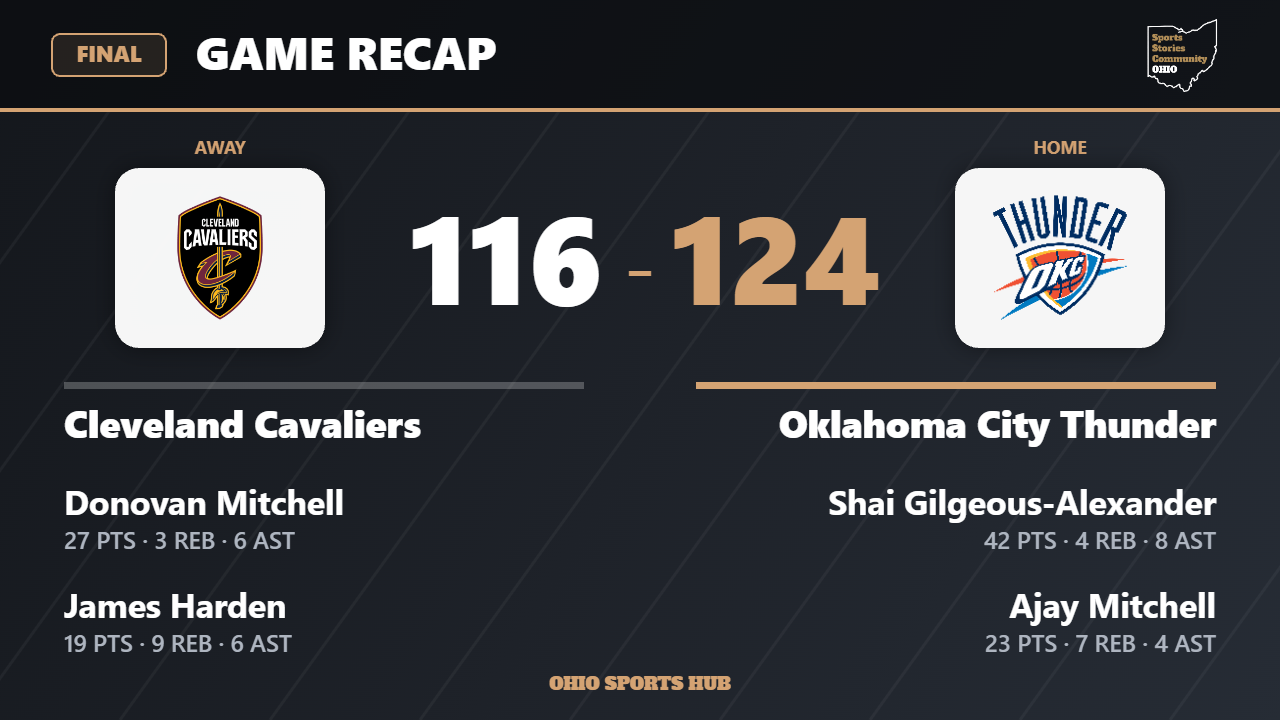
CLEVELAND — The Cleveland Cavaliers nearly pulled off an impressive comeback Wednesday night, cutting a 25-point deficit to six in the final minute against the Oklahoma City Thunder. Although Cleveland ultimately lost 124-116, the performance offered a look at both what makes the Cavaliers dangerous and what continues to prevent them from playing consistently.
Cleveland's problems began almost immediately. The Thunder outscored the Cavaliers 37-20 in the opening quarter, shooting 56.5% from the field and connecting on six of their 10 three-point attempts. Cleveland, meanwhile, made just eight of 23 shots, allowing Oklahoma City to build a substantial lead rather quickly.
The Thunder eventually pushed their advantage to 25 points during the second quarter. Cleveland managed to trim the deficit to 60-44 by halftime, but the early struggles forced the Cavaliers to spend the remainder of the night trying to recover.
Oklahoma City moved the ball effectively, attacked Cleveland in transition, and capitalized on defensive breakdowns. The Thunder finished with 21 fast-break points and 17 second-chance points, compared with Cleveland's 12 and 10, respectively.
The additional scoring opportunities made an already difficult matchup even tougher. When a team is facing an opponent with the offensive talent of Oklahoma City, giving up easy baskets and allowing additional chances around the rim can quickly turn a game in the wrong direction.
However, the Cavaliers showed in the second half that they have enough offensive firepower to compete with anyone.
Cleveland opened the third quarter with nine consecutive points, cutting Oklahoma City's lead to 60-53. James Harden provided seven of those points, helping the Cavaliers find some offensive momentum after their difficult first half.
Although Oklahoma City rebuilt its advantage to 88-74 entering the fourth quarter, Cleveland continued attacking. The Cavaliers scored 42 points over the final 12 minutes, shooting 58.3% from the field and making 10 of 17 three-point attempts.
Donovan Mitchell found his range late, scoring 14 of his 27 points in the fourth quarter. He connected on four three-pointers during the final 3:11, including three in quick succession that brought Cleveland within 117-111 with 47 seconds remaining.
The late offensive surge was impressive, but the Cavaliers had already allowed themselves too little room for error. And by too little, I mean none. Shai Gilgeous-Alexander, who finished with 42 points, made six consecutive free throws in the final 40 seconds to keep Cleveland from completing its comeback.
The Cavaliers have now lost consecutive games against Oklahoma City, and the issue has been their ability to execute consistently, particularly during the opening minutes.
Wednesday's comeback demonstrated how quickly Cleveland can erase a deficit when its offense is working. The challenge is finding that same level of execution from the opening tip rather than waiting until the game is nearly out of reach.