











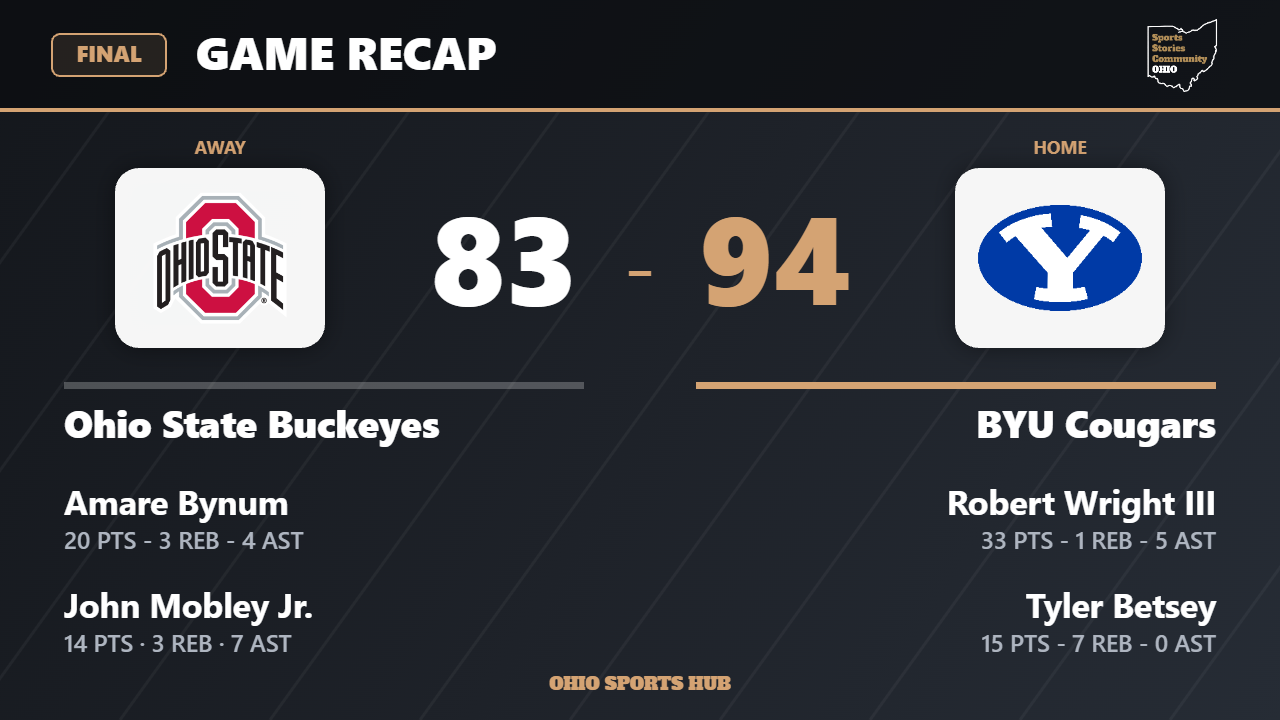



COLUMBUS — Ohio State's 94-83 season-opening loss to No. 25 BYU on Monday night wasn't the result of a poor offensive performance. The Buckeyes scored 83 points, shot nearly 50% from the field, and led for much of the first half. Unfortunately, their defense was downright atrocious over the final 20 minutes.
BYU scored 60 second-half points, shooting 69% from the field and 70% from three-point range. Those numbers are unacceptable for a team hoping to compete near the top of the Big Ten, and the problems went well beyond the Cougars simply having a hot shooting night.
BYU repeatedly spread the floor, creating room for its guards and wings to attack Ohio State defenders. Far too often, the Cougars beat their defenders off the dribble and drove toward the basket with little resistance. When the Buckeyes tried to help, BYU had shooters waiting on the perimeter, creating another problem Ohio State struggled to solve.
The Buckeyes rarely seemed capable of stopping the initial penetration, leaving their interior defenders to deal with players already attacking the rim. Defensive rotations were frequently late, and BYU took advantage of the resulting openings throughout the second half.
Robert Wright III was particularly difficult for Ohio State to contain. The BYU guard finished with 33 points, including 19 after halftime, while shooting 9-of-15 from the field and 4-of-5 from three-point range. His ability to attack the basket and score from outside made him a matchup problem the Buckeyes never solved. Indeed, it seemed like they never solved anything once BYU got rolling.
The defensive shortcomings became especially damaging after Ohio State briefly regained a 57-55 lead with approximately 12 minutes remaining. The teams traded baskets before BYU took control with a 14-2 run that helped the Cougars build a 73-61 advantage with 7:24 left. Ohio State never recovered.
Ohio State coach Jake Diebler acknowledged the problems afterward, saying his team needed to improve its execution of defensive coverages.
"We got to be better at executing our coverage defensively," Diebler said. "I mean, we scored enough points on the road. You got to be in position at the end of the game to get something good to go your way, but we just we didn't get enough stops."
Diebler's assessment was accurate. Ohio State shot 49.1% from the field, made 18 of 19 free throws, and received solid offensive contributions from Amare Bynum, John Mobley Jr., Andrija Jelavic, and Justin Pippen. The Buckeyes also outrebounded BYU 31-30, eliminating one potential explanation for the loss.
The problem was their inability to prevent BYU from getting the shots it wanted. The Cougars made 20 of their 29 second-half field goal attempts, including seven of 10 three-pointers. Even when Ohio State scored, it couldn't consistently follow those baskets with defensive stops.
There is plenty of time for Diebler to correct these problems, and one loss to a nationally ranked opponent doesn't define a season. However, the defensive effort Monday night was nowhere near good enough, regardless of who they were playing.
The Buckeyes showed Monday that they can score, but they'll have to do a much better job of stopping their opponents if they hope to compete in the Big Ten.